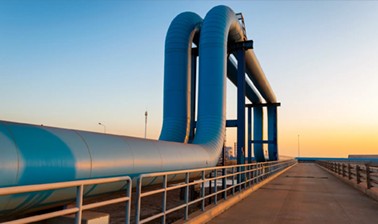

AIR-PREHEATER WITH LASER WELDED PLATES
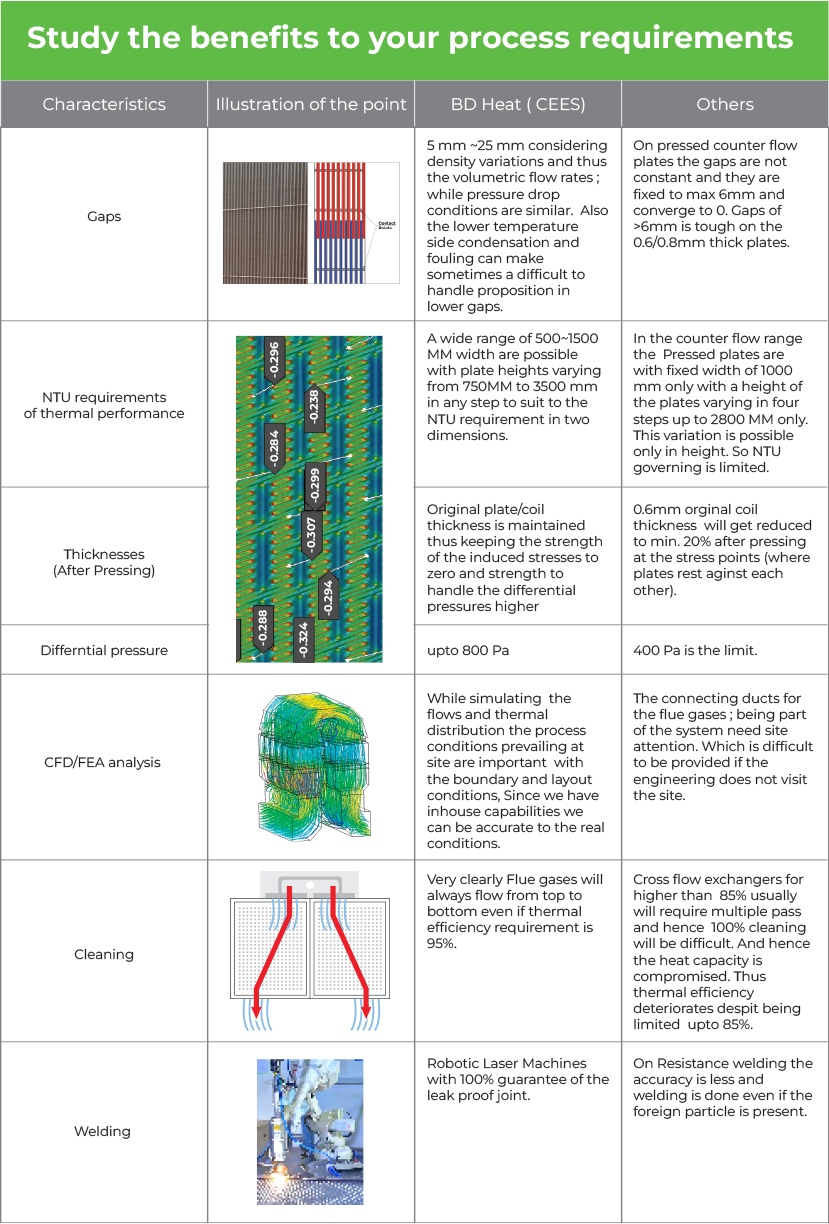
Recuperative Laser welded plate heat exchangers are utilized in Ammonia, Methanol and Hydrogen Reformers with thermal efficiencies in excess of 95% with counter flow concept. Under the continuous success of the 'Make in India' program; B3E Heat has partnered with Clean Earth Energy Solution India Pvt Limited to develop the import substitute product 'Welded Plate type Air preheater’ in India and create 'CEES' as the hub for the India as an exclusive partner for B3E Heat.
Our designs which are unmatched for benefits on CAPEX and OPEX combined. CEES shall partner with B3E Heat as the manufacturing base for the Middle East Market. You may plan to debottleneck with increased heat recovery and throughput, without fan and foundation modification.
DEW POINT is an important consideration while designing a successful CAPH. Below are important indicators.
In the heavy oil uses as fuel the S (Sulphur) presence during burning generates SO2 and SO3. Generally, about 3% S produces 0.15% SO2. 3% or 30 PPM of which becomes SO3. Below illustrations signify that 30 PPM of SO3 inclusion leads to the dew point of 130 degree ~140-degree C. At a temperature below this level if prevails on the heat transfer surface, acid dew point corrosion may take place depending on the metallurgy of the plate.
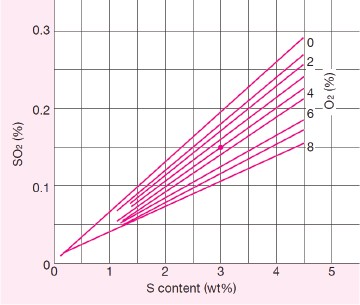
Relation between Sulfer Content and SO₂ Content in Combustion Gas
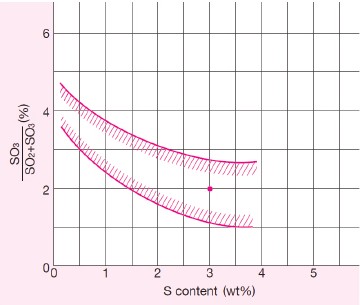
Relation between Sulfer Content in Fuel and SO₂ to SO₃ Conversion Rate
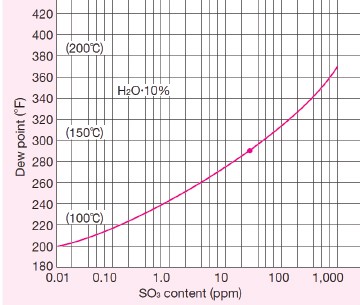
Relation between SO₃ Content in Combustion Gas and Dew Point
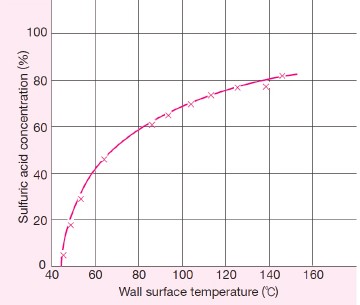
Relation between Wall Surface Temperature and Sulfuric Acid Concentration
1) H. Kuroda et al.: Thermal Power, 16 (1965), 537. Thermal and Nuclear Power Engineering Societ
CORROSION PROTECTION OF AN APH
The choosing of material is critical especially for Cold Stage of the APH where flue gas temperatures are cooled down close to dew point temperatures. This then becomes an ideal situation for Sulphuric acid formation as shown below in the chemical reaction.
SO2 + H2O → H2SO3 (Sulfurous Acid) & SO3 + H2O → H2SO4 (Sulfuric Acid)
NH3 in the fuel can form Ammonium Bisulfate in the APH and cause severe corrosion at higher temperature.
NH₃ + SO₃ + H₂O → NH₄HSO₄ (Ammonium sulfate)
2NH₃ + SO₃ → (H₂O₄)₂SO₄ (Ammonium bisulfate)
For selection of the right material, we use PREN number to classify and conclude the best choice of material to prevent in operation corrosion. PREN number stands for Pitting Resistance Equivalent Number. The calculation of PREN number for a specific material depends upon the composition of the material. It is based on the linear formula as below, which is the weighted sum of the composition elements.
PREN = Cr + m Mo + n N
2) where 'm' and 'n' are the factors for molybdenum and nitrogen.
2) https://www.sciencedirect.com/topics/engineering/pitting-resistance-equivalent